Tuesday, 13 August 2013

Life in the Bronze Age

The event was centred around the recently built bronze age roundhouse at Brodick Castle.


There were archaeologists inside the roundhouse, making what I guess was what I made at guides years ago - damper ( an early form of unleavened bread)...


... and telling tales of life in the bronze age - and medicines from then.


The roundhouse is fantastic, it must have been a great experience working on building it with the NTS rangers.

Outside there was pot making. The potter was very interesting to talk to;  he's also making replica pots for the new Stonehenge visitor centre. Sadly I didn't make notes and have forgotten a lot of what he said about the timings for firing the pots beside a fire like this.


I do remember him telling me about some of the experimental archaeology he's done though. He left some broken pots lying outside in his garden for 2 years. It was a great illustration of how quickly archaeological remains can be lost if they don't have some sort of protection.

After the first winter the pots had been broken by pots into smaller pieces, but were still recognisable and could presumably still be rebuilt by archaeologists (a bit like a jigsaw). During the 2nd year insects moved in to the layers in the weathered pots and started making their homes there.The weathering continues and frost plays its part in continuing to weather and break up the pots.  Then of course, birds spot the insects and start moving about the broken, and increasingly small, pieces of pottery in search of a tasty meal. He said that after 2 years all that was really left was 'dust' and the odd small piece of pot. Amazing! So in what is really an incredibly short time archaeologically speaking there could be no evidence remaining of what was originally there.

That's an experiement I'd love to repeat with a class at school, if I could find the right context - and (much harder) a place where the pots wouldn't be disturbed by humans!

I'd also love to recreate the burnt mound experimental archaeology with pupils, but doubt I'd be allowed to.  As for the brewing...

In the 'small world' way that things often work, it was someone from Orkney who was running the burnt mount archaeology part of the event.


This was a chance to experiment with the type and size of stone (though a lot will be known about that from what's found in burnt mounds) as well as how long the stones would need to be heated for, how often they could be heated before cracking and how fast the water would boil, how many stones it would need, etc. The first task they had to think about was how to seal the water tank - I think it was a local clay that was used.

The stones were heated for a couple of hours in the fire and then moved down to the tank...


... where they were pushed over the edge ...


... and landed with a splash.


It was incredible (to me anyway) how fast the water boiled, it certainly didn't take all of the stones which had been heated to make the water come to the boil within minutes.

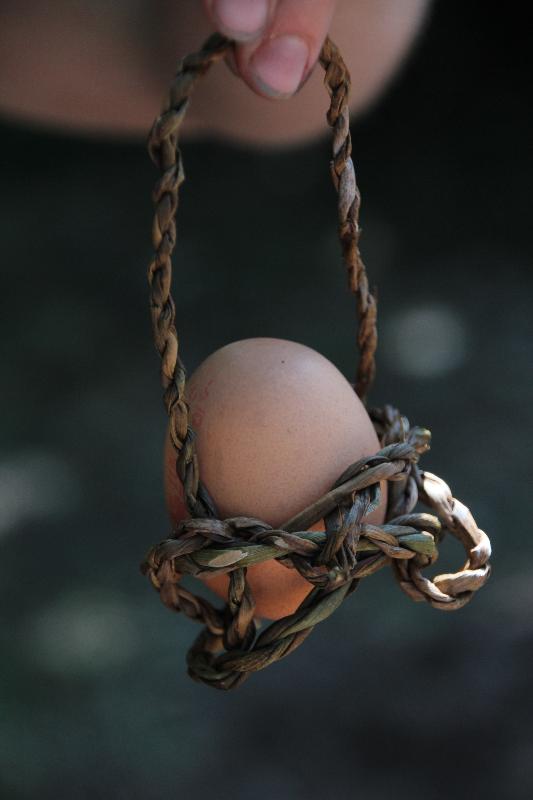
Then it was time to boil an egg for lunch...


An unexpected (or less planned for anyway) part of this experiment was trying to work out how to get the boiled egg back out, not least because some of them vanished in amongst the stones in the boiling water! A short while later, and the egg holder was born! Made out of reeds I think.


Monday, 12 August 2013

Experimental Archaeology

I was lucky enough to catch an experimental archaeology event when I was in Arran at the start of the summer holidays. It ws organised by the Arran Ranger Service with Northlight Heritage, the Arran Brewery, and more. I don't think it was particularly well advertised, but that would be my only real criticism of what was a fantastic event. It was fairly quiet, probably as a lot of folk locally didn't seem to know anything about it, but that added to the experience for me in a way - especially during the day - as it meant you got the chance to see things really clearly, spend lots of time without being rushed, and chat to the archaeologists.

I don't know whether the archaeologists themselves would have preferred it busier - presumably that varies as some were happy to chat and explain what they were doing whereas others seemed to prefer to just get on with their experiements in 'bringing the past to life'.

Anyway, it was a great event and I'd highly recomment to people that they should attend events like this if they get the chance.

They build a post circle in the grounds of Brodick Castle, below Goatfell. I hadn't realised previously, but these would have been very common around Scotland at one time, and in fact there is apparently evidence of post circles on Machrie Moor, presumably predating the well-known stone circles there.


Machrie Moor stone circles
 
The post circle, the first to be erected in Arran for over 4000  years.


Some traditional 'tools' were used to dig the post holes, although I believe modern tools were 'resorted to' as well.

 
The circle with Goatfell towering over it.  Later in the weekend it would be set alight...


Thursday, 18 July 2013

A Trip "Sooth"

Having lived in Orkney for so long, a trip "sooth" still means anywhere south of where I live. So my trip to Arran last week was a trip sooth. I stopped off at a couple of other places to break the journey, and - as usual - got busy with the camera.

 Robin

Juvenile redpoll
 
 Redpoll - the first one I've ever seen.
 
 Goldfinch
 
 Siskin
 
  Pond skater
 
 Water lillies
 
Eryngium
 
I also came across a very pretty roundabout...


All good.


Monday, 15 July 2013

More Arran Wildlife

Some hielan coos, and a tystie.


A field of Hielan Coos at Brodick Castle.


At Brodick Pier - a tystie (black guillemot) with its dinner.


Sunday, 14 July 2013

Some Arran Wildlife

On a beautiful evening I went for a paddle in Lamlash Bay to cool down.


There were lots of small fish but I'm not sure what kind.


There were small flatfish too but I didn't manage to get a photo of them as you could really only see them when they were moving. There were shrimps...
 
 
... and there were lots of hermit crabs. The water was warm and beautifully clear.


In fact the water was so warm that it didn't do much to revive me, which was the original idea behind going for a paddle in the sea! However something else did much to revive me...


The sea creatures didn't seem too bothered by the presence of my feet. First this crab ran right over me, then I spotted a very busy hermit crab...

It was testing out a new shell for size. I knew that hermit crabs were soft bodied and that when they needed a bigger shell they had to find an empty one and then move quickly before any predators caught them, but I've never seen it actually happening before. This hermit crab spent ages getting the shell into the perfect position, then he quickly nipped into the bigger shell. He then maybe thought it was a little too big as he then scuttled back into his old shell again, before finally moving back into the new shell and heading off.


What a sight.  It certainly made my day!